
 Individual

- Home>
- Insurance Calculators>
- Income Tax Calculator
Income Tax Calculator - FY 2026-2027
An Income Tax Calculator is a user-friendly online tool, which helps you in calculating your income tax based on the taxable income. You can calculate income tax online under both old tax regime and new t
...Read MoreCalculate your Income Tax
Basic Details
Income Details
Deductions
Tax Paid

Congratulations!
You have no tax liability.
Recommended Plan for you

Create wealth for your and your family’s future goals
With Axis Max Life Investment Plans
- 100% Guaranteed returns*#
- Save tax up to Rs. 46,800##
Axis Max Life Savings Plans


Trust of 20+ Years in Industry


Written byAbhishek Chakravarti

Reviewed byAlok Mishra
Last Modified 3rd October 2026
Taxation & Finance Expert

What is Income Tax Calculator?
An Income Tax Calculator is an easy-to-use online tool that can help you calculate taxes on the basis of income tax slabs applicable on your taxable income.
Using an income tax calculator, you can easily organize and prepare your financial statement for the current financial year while taking steps to maximize your tax savings. The availability of an online income tax calculator also makes it both accessible and easy to use for estimating your net taxable income (after deducting various investments and expenses).
The income tax calculator has been updated to reflect the latest provisions announced in the Union Budget 2026 for both the new as well as old tax regime. So, this tax calculator features revised income tax slab rates, standard deduction, and various rebates applicable under the new tax regime as well as the old tax regime. This way, you can compare the tax liability under both tax regimes and choose the one which helps you save more tax.
The income tax calculator can help manage the needs of various categories of taxpayers. This tax calculator can be convenient used by salaried individuals, freelancers, business owners, professionals, NRIs, HUFs and more. Using this free online tool can help ease the tedious task of calculating due income tax so that it is easier to engage in appropriate tax planning.
Let’s check how to calculate income tax online by using the tax calculator available online.
How to Calculate Gross Income from Different Sources of Income?
To calculate tax online using Income tax calculator 2025, you need to compute your gross income. Gross income is classified into 5 categories while filing ITR online:
- Income from Salary
- Income from Business or Profession
- Income from House Property
- Income from Capital Gains
- Income from Other Sources
Also, you can claim a Standard Deduction of Rs. 50,000 from your annual income for the financial year 2025-26 under the old tax regime and Rs. 75,000 under the new regime.
In the Union Budget 2025-26, the tax slabs of the Old Tax Regime for FY 2025-26 have remained the same as FY 2024-25. However, the number of income tax slabs have changed for the new tax regime for FY 25-26 as compared to FY 24-25.
Let’s understand these categories in detail below.
Income from Salary: Under this you need to add monthly income that you are earning by working for an employer. If you are a salaried employee, you can add your income under salary head. The salary you receive consists of components like Basic Salary, House Rent Allowance (HRA) , Dearness Allowance, Gratuity, Provident Fund, travel allowance, or any other allowances. You can check all these components in your Salary Slip that your employer will be providing you every month
Income from Business or Profession: Under this head you need to enter all the income from any business activity or by practicing a profession. The income that one earns through business or profession is also taxable
Income from House Property: Income from House Property includes all the rent income that you are earning through renting out any residential or commercial property. You will be required to pay taxes on rental income as well
Income from Capital Gains: Capital Gains include any profit or gain through sale or transfer of capital assets like stocks, mutual funds, property or real estate etc. Capital Gains are divided into Short Term Capital Gains (STCG) and Long Term Capital Gains (LTCG) on the basis of duration for which you stay invested. This categorization is also necessary as the taxation differs for STCG and LTCG
Income from Other Sources: Any income that does not fall under the heads mentioned above will come under Other Sources. This will include any income from lottery, gift (more than Rs.50,000 per annum), bank interest etc.
How to Calculate Income Tax of a salaried employee?
The Government of India mandatorily deducts income tax from both salaried and self-employed individuals. As a salaried individual, your monthly salary comprises different components such as basic salary, HRA, transport allowance, and other special allowances. Few of these allowances are tax-exempt. Thus, you need an online income tax calculator to calculate your gross taxable income and available tax-deductibles. Without knowing how to calculate income tax, you may end up overpaying income tax.
Step 1: Calculate Gross Income
Write down your total income, including the allowances in the income tax calculator window. Significant exemptions that you receive on different salary components include House Rent Allowance (HRA) and Leave Travel Allowance (LTA). Remove these components from your gross annual salary.
House Rent Allowance is generally considered the lowest of the following values:
- House rent allowance received from the employer
- Actual rent paid less 10 percent of basic+DA monthly salary
- For a metro city, 50% of the basic salary
- For a non-metro city, 40% of the basic salary
After making all necessary deductions with the help of an income tax calculator, you must declare income received from different other sources, such as capital gains, and deposits. The resulting value is your total gross income.
Step 2: Calculate Net Taxable Income
Various instruments offer tax-saving benefits to further lower your taxable income under Section 80C of the Income Tax Act 1961. The income tax calculator helps you enumerate and compile the details of these tax-saving investment options. Standard tax-saving instruments include:
House Rent Allowance is generally considered the lowest of the following values:
- Life insurance
- Unit Linked Insurance Plans (or ULIPs)
- Mutual funds
- Equity Linked Savings Schemes (or ELSS)
- Public Provident Fund (or PPF)
- National Pension System (or NPS)
Section 80C
Both individuals and HUF members can avail of tax deductions up to Rs. 1.5 lakh under Section 80C. Popular tax-saving instruments under this Section include Public Provident Fund (PPF), Life Insurance policies, Employee Provident Fund (EPF), Home Loan repayment, National Saving Certificates (NSC), and Equity Linked Savings Scheme (ELSS).
An online income tax calculator incorporates all such deductions to help you calculate your total taxable income with ease.
Section 80CCD (1)
The contribution towards NPS is eligible for tax deduction under this Section. If you want to know the values beforehand, an income tax calculator is the perfect online tool.
For a salaried employee, it is 10% of the gross salary with a given limit of Rs 1.5 lakh under section 80 CCE.
Section 80CCD (1B)
Both salaried and self-employed individuals can avail of an additional tax deduction of Rs 50,000 under this Section, over and above that provided under Section 80C. Together, thus, you can save up to Rs. 2 lakhs under Section 80C and Section 80CCD (1B). You can easily declare your NPS contributions on an income tax calculator while calculating your tax liability.
Section 80D
The premium amount paid towards health insurance is tax-deductible under Section 80D for both individuals and HUF members. The maximum amount of deductions claimable is calculated as per the following criteria:
- Rs 25,000 deduction on self-medical insurance, spouse and children’s medical insurance
- Additional Rs 25,000 deduction on the insurance of parents ageing below 60 years
- Additional Deduction of Rs 50,000 when the individual and parents, both are above 60 years of age
Section 80DD
This Section is also applicable to individuals and HUF, who can make deductions for the medical expenditures of a dependent disabled member of the family. You can get deductions up to Rs 1.25 Lakh depending upon the disability of the person
You can provide details of your expenses under this Section on an income tax calculator.
Section 80E
The Section applied to only individuals includes deduction on the interest paid towards education loan. The deduction in section 80E can be enjoyed 8 years only.
Step 3: Tax Slab Based on Net Taxable Income
In the Union Budget 2025-26, the tax slabs under Old Tax Regime have remained the same as FY 2024-25, however there has been few changes in the new tax regime slabs and rates. While the tax filing process has become easier under the new tax regime, the calculation of income tax liability has become hassle-free, too – thanks to the availability of various online income tax calculators.
After subtracting all qualifying deductions from your total annual income using an online income tax calculator, you will get the value of your net taxable income. As per existing tax slab rates, you will have to pay taxes according to the category your income falls in. You can also take help from an online income tax calculator to do the calculations as per the applicable tax slab.
Step 4: Calculate Taxes
You may consider tax calculation to be cumbersome. To make the process smooth, therefore, you can use an online income tax calculator available on the Income Tax India site.
Step 5: Consolidate Net Taxes
The last step is to consolidate the net tax payable by deducting all applicable deductions and exemptions based on the tax saving investments made by you. In this step you also need to consider if you qualify for the rebate under Section 87A.
Section 87A Rebate:
Tax rebate is a type of benefit offered by the Government of India to individuals whose net taxable income does not exceed Rs. 5 lakhs. Thus, if your total taxable income is less than Rs. 5 lakhs, you can claim an additional rebate of up to Rs. 12,500 on the total tax payable (before adding health and education cess of 4% into the tax calculated in the previous step) under the old tax regime. Under the new tax regime, Section 87A limit is up to Rs. 60,000 applicable to taxable income of up to Rs. 12 lakh for the fiscal.
Since you have calculated net taxable income with the help of an income tax calculator, you can deduct the aforementioned tax rebate, if applicable.
Similarly, if the net taxable income exceeds Rs 5 lakhs or 12 lakh as per the applicable tax regime, you will not be able to avail of the tax rebate under this Section.
With the help of an online income tax calculator, you can calculate your net taxable income on which you have to pay tax. Although the process may seem complicated, using an online income tax calculator can make it easier for you to get accurate values.
The main objective of an income tax calculator is to get proper methods of saving tax through various deductions to reduce tax liabilities.
How to Compare Old vs New Tax Regime Using an Income Tax Calculator?
An income tax calculator allows comparing your income tax liability under both old and new tax regimes while accounting for income, deductions, exemptions, rebates, and tax rates. You can enter the same income figures for both regimes and compare the total tax payable to determine which regime allows you to save on taxes.
1. Calculate Tax Under New Regime
Enter the details of the gross income earned from salary and other sources during the year to let the calculator determine your taxable income after applicable deductions and slab rates. While the new regime does not provide traditional exemptions like HRA or LTA, it still allows specific deductions such as the standard deduction and employer contributions to NPS.
2. Calculate Tax Under Old Regime
The old regime calculation covers the salary information, components (like HRA/LTA), and other income sources. The calculator uses the appropriate standard deduction and traditional tax rates. Eligible exemptions and deductions may lower your taxable income.
3. Compare Deductions & Exemptions
For a comparison of the available deductions, it is important to understand how much each regime can help to reduce the overall tax liability for the year. The old regime offers you benefits including Section 80C deductions up to ₹1.5 lakh, Section 80D, NPS contributions, HRA exemption, and eligible home loan interest. The new regime offers fewer traditional deductions and exemptions.
4. Compare Total Tax Payable
Marginal relief, surcharge, health and education cess of 4% and rebates, if applicable, should be added to the final tax rates in both systems and compared. This provides a realistic measure of the actual tax burden, and not just a comparison of the tax rates in different slabs.
5. Choose the Suitable Tax Regime
The appropriate system depends on net tax liability (after income, deductions, exemptions, investments, etc.). For people who have fewer deductions, the new regime might be more beneficial, whereas the old regime may be helpful if they have other benefits under HRA, Section 80C, Section 80D, NPS, or a home loan that significantly reduce their taxable income.
Special Considerations for Gross Income Calculation
At the time of entering your gross income details in the income tax calculator, you should keep in mind some key factors:
Clubbing of income
As per the clubbing provisions of the Income Tax Act, certain incomes must be included in your gross income. For example, the earnings of a minor child earns income from an investment in their parents’ fund, it would be included in the parents’ total income.
Similarly, income transferred to a spouse might be clubbed except in specific exempted cases. Hence, it is necessary to understand these rules to ensure accurate tax calculation. Also, being cognizant of these income clubbing rules can help avoid possible under-reporting of income. This can help reduce the chances are.
Similarly, income transferred to a spouse might be clubbed except in specific exempted cases. Hence, it is necessary to understand these rules to ensure accurate tax calculation. Also, being cognizant of these income clubbing rules can help avoid possible under-reporting of income. This can help reduce the chances are.
Tax-Free Sources
Some income sources, like agricultural income or certain such as travel allowance, communication allowance, etc., are exempt from income tax. When calculating gross income, these incomes should be properly declared at the time of tax filing to ensure that possibility of an Income Tax notice is reduced.
Deduction at source
Gross income is the total earnings of an individual. It should be represented before accounting for deductions such as Tax Deducted at Source (TDS). Then, TDS is adjusted separately when filing income tax returns, it should be deducted when declaring gross annual income for tax purposes. In most tax calculators, there is a separate field where you can input the TDS amount already deducted, so that your final tax liability is decreased by the applicable amount at the time of filing your returns or calculating your refunds.
Who All Should Ideally File Their Income Tax Returns?
The main purpose of filing an ITR is to report your earnings, expenses, and income tax liability for a particular tax year. Check out the common types of individuals who are required to file their income tax returns:
Individuals Earning More Than the Basic Exemption Limit
Individuals whose gross annual income is more than the basic exemption limit are required to file an income tax return. The specific exemption limit varies depending on the tax regime chosen and the age of the taxpayer. Under the new tax regime, the basic exemption limit is ₹4 lakh regardless of the taxpayer's age.
On the other hand, the basic exemption limit under the old tax regime varies based on the age of the tax payer. As per current rules, basic exemption limit is ₹2.5 lakh for individuals below 60 years, ₹3 lakh for people between 60 and 80 years, and ₹5 lakh for those above 80 years. Any individual with income exceeding these limits is legally required to file ITR.
On the other hand, the basic exemption limit under the old tax regime varies based on the age of the tax payer. As per current rules, basic exemption limit is ₹2.5 lakh for individuals below 60 years, ₹3 lakh for people between 60 and 80 years, and ₹5 lakh for those above 80 years. Any individual with income exceeding these limits is legally required to file ITR.
Individuals with Taxable Income After Deductions
Income tax filing is mandatory for individuals whose income exceeds the applicable exemption limit after accounting for all deductions allowed under the Income Tax Act. Under the old tax regime, individuals aged up to 60 years with gross annual income of more than ₹2.5 lakh after considering the applicable deductions must file their income tax return. This limit is higher at ₹3 lakh in a tax year for taxpayers aged between 60 years and less than 80 years. Similarly, this limit is ₹5 lakh in the case of taxpayers aged 80 years or above, if they opt for the old tax regime.
In the case of individuals opting for the new tax regime, if annual taxable income after eligible deductions under the new tax regime exceed ₹4 lakh, the taxpayer is required to file their Income Tax Return.
In the case of individuals opting for the new tax regime, if annual taxable income after eligible deductions under the new tax regime exceed ₹4 lakh, the taxpayer is required to file their Income Tax Return.
People Undertaking High-Value Financial Transactions
People making high-value financial transactions may be required to file the ITR even if their gross annual income is below the basic exemption limit. Examples of such high-value transactions include spending more than ₹2 lakh on foreign travel in a year, paying electricity bills of ₹1 lakh or more in a month, depositing more than ₹50 lakh in savings bank accounts during the tax year, or depositing ₹1 crore or more into a current account during the tax year. If you have made one of more of these transactions, you are required to file your income tax return.
Business Owners, Freelancers and Professionals
Business owners and professionals may be required to file an income tax return based on their income or business activities. Additionally, companies and business firms must file income tax returns regardless of their gross profits or incurred losses. Business owners and professionals may use ITR-3, while freelancers and certain eligible self-employed professionals may file ITR-4 if they opt for the presumptive income scheme.
NRIs and Foreign Nationals Receiving Income from India
Non-resident Indians and foreign national who earn income in India must file their income tax return irrespective of the income earned in India during the tax year. This is a mandatory requirement as per current income tax rules ans typically, depending on the type of income earned, the choice of ITR form will vary accordingly.
Individuals Claiming Tax Refunds
Individuals who have paid more tax than their actual tax liability in a particular tax year need to file a income tax return to claim the refund. Excess tax payment may be as a result of TDS or self-assessment tax paid exceeding the final income tax liability. Filing an income tax return is necessary if the taxpayer wants to claim the excess tax paid back from the tax authority.
Individuals Required to File ITR Under Specific Conditions
Some individuals may need to file an income tax return due to specific reasons, even if their income during the tax year does not exceed the basic exemption limit. Some examples of these special conditions include resident taxpayers with assets or business interests in foreign countries, residents who are authorised signing authorities for foreign accounts, individuals who receive income from foreign sources, etc.
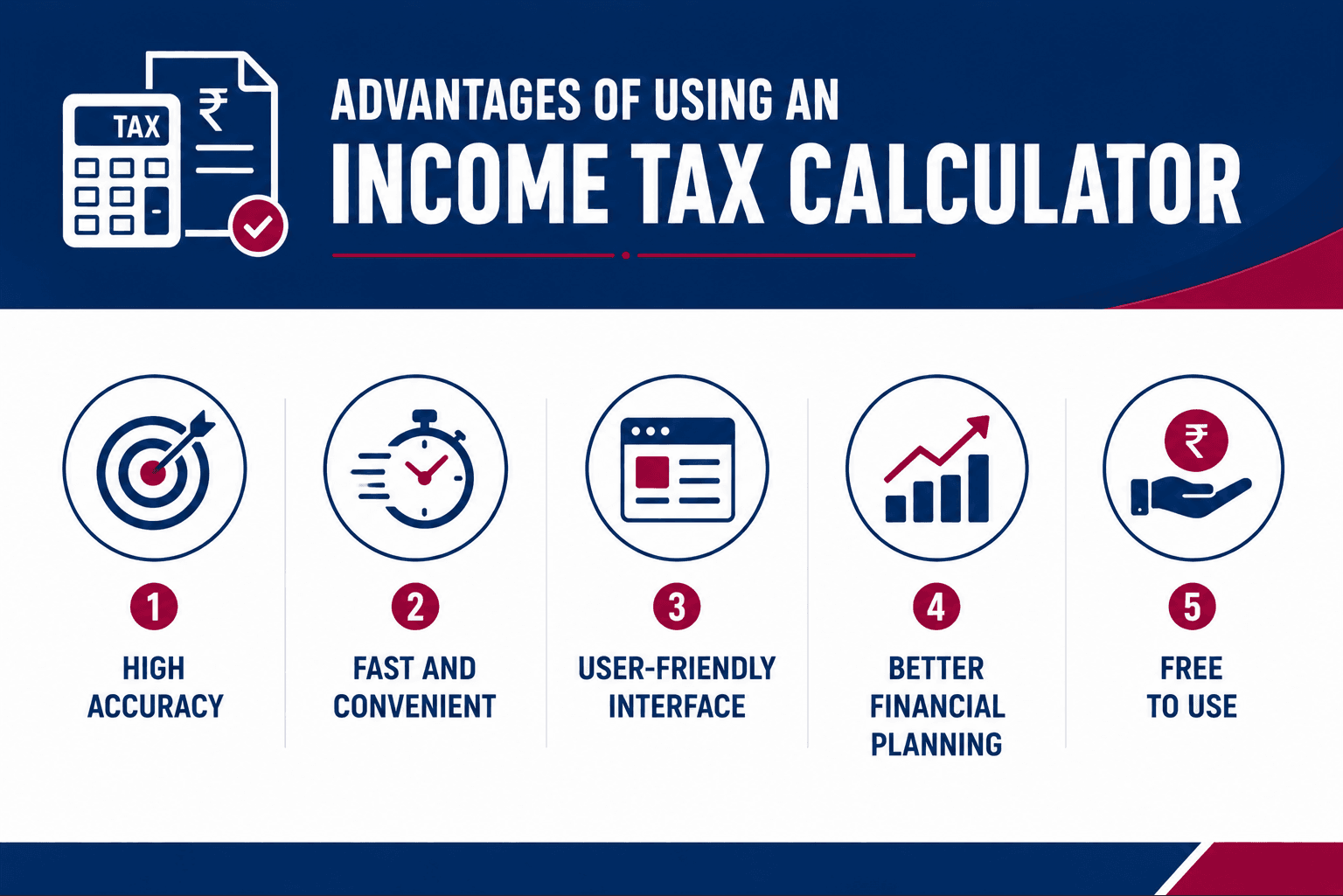
Advantages of Using an Income Tax Calculator
Long term financial stability requires an efficient tax management strategy. The key goal of an Income Tax Calculator to make tax calculations quick and easy for the user. Here are the key advantages of using this online tool for calculating income tax dues.
High Accuracy
The income tax calculator uses the current income tax rates, slabs, and rules to deliver accurate results. It supports multiple income sources for the tax calculation. Additionally, it automatically applies various deductions, rebates, and exemptions when making the calculation. This way, it reduces the risk of manual errors that could lead to overpayment or underpayment of taxes.Fast and Convenient
Calculations done using an online income tax calculator offer a quick and hassle free experience. You just need to enter the income and deduction details. Then it will automatically compute tax liability under both the old and new tax regimes. This way it saves you both time and effort.User-Friendly Interface
The tax calculator comes with an user-friendly interface. As a result, everyone, including individuals with limited tax knowledge, can use the calculator easily to calculate returns. This feature of the tax calculator ensures that you can use the income tax calculator without any help from tax professional.Better Financial Planning
By providing a precise estimate of tax liability income under both tax regimes, the Income Tax Calculator supports effective financial planning. You also have the option to check the impact of various deductions and exemptions as per you current and future financial plans. These can provide valuable insight help you enable smarter investment and savings decisions.Free to Use
The income tax calculator is free to use online and can be used unlimited times. All you need is a stable internet connection to visit the Axis Max Life website and use the income tax calculator.
How to Use Income Tax Calculator Online for FY 2026-27 (AY 2027-28)?
An online income tax calculator is a tool to estimate your income tax liability based on your annual income, deductions, allowed exemptions, and the selected tax regime. Its use during FY 2026-27 (AY 2027-28) will facilitate understanding a comparison between the old and new tax regimes before filing an income tax return. To calculate your tax liability, here are the steps to follow:
Step 1: Visit the Income Tax Calculator Online
Begin by visiting the official Income Tax e-Filing portal and opening the homepage. To access the calculation tools, click on ‘Income and Tax Calculator' under the Quick Links section. Depending on the detail required, choose either the default Basic Calculator or switch to the Advanced Calculator tab for a more detailed tax estimate.
Step 2: Select the Assessment Year and Taxpayer Details
To calculate the applicable tax for the relevant financial year, please select AY 2027-28 (FY 2026-27). Then, provide the necessary taxpayer information, including the taxpayer category, residential status, and age group.
With these details, the calculator can use the applicable tax rules and calculate the tax to be paid. After the information is completed, click on ‘Next' or ‘Continue' and provide further details.
With these details, the calculator can use the applicable tax rules and calculate the tax to be paid. After the information is completed, click on ‘Next' or ‘Continue' and provide further details.
Step 3: Enter Your Income Details
Enter your annual income earned from salary, business or profession, house property, and other sources. Include additional earnings (if any) from savings account and/or fixed deposit interest, wherever applicable.
Based on the selected regime, the calculator factors in the applicable standard deduction, which is ₹75,000 under the new regime and ₹50,000 under the old regime, to arrive at the taxable income.
Based on the selected regime, the calculator factors in the applicable standard deduction, which is ₹75,000 under the new regime and ₹50,000 under the old regime, to arrive at the taxable income.
Step 4: Enter Deductions and Tax-Saving Investments
Enter details of the tax-saving investments and deductions eligible under the selected regime. These may include Section 80C benefits of up to ₹1.5 lakh, Section 80D health insurance premiums, NPS contributions, HRA exemption, and eligible home loan interest.
The calculator considers only the deductions permitted under the chosen regime, with the new regime offering limited benefits as compared with the old regime.
The calculator considers only the deductions permitted under the chosen regime, with the new regime offering limited benefits as compared with the old regime.
Step 5: Compute and Compare Your Tax Liability
Once you have entered all income and deduction information, click on ‘Calculate’ to produce the estimated tax liability. Check the tax calculation, including tax slabs, 4% health and education cess (where applicable), and any applicable Section 87A rebate.
The calculator also allows you to compare the estimated liability under the old and new tax regimes, which makes it easier for you to identify the regime that may result in a lower tax outgo based on the entered details.
The calculator also allows you to compare the estimated liability under the old and new tax regimes, which makes it easier for you to identify the regime that may result in a lower tax outgo based on the entered details.
Income Tax Slab Rates for New and Old Regime
Currently two different Income Tax regimes co-exist in India and individuals can opt to pay taxes under either of the new income tax regime old the old tax regime. In the case of the new tax regime, lower rates of taxation are applicable to higher income groups.
Although you can get an idea of all the tax rates by using an income tax calculator, it is essential to know that the tax slab rates depend upon your age and income group as well as the tax regime you have chosen. After knowing all such details, you can calculate to know the details of your tax liabilities.
New Tax Regime Slabs: FY 2025–26
This is what the new income tax slab rates look like for AY 26-27::
| Net Taxable Income | Applicable Tax Rate | Tax Amount |
|---|---|---|
| Up to ₹4 lakh | Nil | ₹0 |
| More than ₹4 lakh and up to ₹8 lakh | 5% on income exceeding ₹4 lakh | ₹20,000 |
| More than ₹8 lakh and up to ₹12 lakh | 10% on income exceeding ₹8 lakh | ₹40,000 |
| More than ₹12 lakh and up to ₹16 lakh | 15% on income exceeding ₹12 lakh | ₹60,000 |
| More than ₹16 lakh and up to ₹20 lakh | 20% on income exceeding ₹16 lakh | ₹80,000 |
| More than ₹20 lakh and up to ₹24 lakh | 25% on income exceeding ₹20 lakh | ₹1,00,000 |
| Above ₹24 lakh | 30% on income exceeding ₹24 lakh | As applicable |
The below table shows the old tax regime slabs and rates for AY 26-27 if the tax payer is less than 60 years old:
| Net Taxable Income | Old Tax Regime Income Tax Slab Rates FY 2025-26 |
|---|---|
| Up to Rs 2.5 lakh | Exempt |
| Rs 2,50,001 to Rs 5 lakh | 5% on taxable income exceeding Rs. 2.5 lakh |
| Rs 5,00,001 to Rs 10 lakh | 12,500 + 20% on taxable income exceeding Rs. 5 lakh |
| Over Rs. 10 lakh | 112,500 + 30% on taxable income exceeding Rs. 10 lakh |
The above old tax regime slabs and rates are also applicable to HUF (Hindu Undivided Family) taxpayers as well as other non-individual tax payers such as Association of Persons (AoP), Body of Individuals (BoI), etc. for AY 2026-27.
The new tax regime does not offer fifferent slabs and rates based on the age of the investor. However, there are differences in the case of old tax regime. Tax slab rates in FY 25-26 (AY 2026-27) for senior citizens between 60 to 80 years under the old tax regime are:
| Net Taxable Income | Old Tax Regime Income Tax Slab Rates for Senior Citizens (FY 2025-26) |
|---|---|
| Up to Rs 3 lakh | Exempt |
| Rs 3,00,001 to Rs 5 lakh | 5% on taxable income exceeding Rs. 3 lakh |
| Rs 5,00,001 to Rs 10 lakh | 12,500 + 20% on taxable income exceeding Rs. 5 lakh |
| Over Rs. 10 lakh | 112,500 + 30% on taxable income exceeding Rs. 10 lakh |
Similarly, super senior citizens opting for the old tax regime also have a higher exemption limit as compared to super senior citizen tax payers opting for the new tax regime.
Income Tax Slabs for Super Senior Citizens (above 80 years of age) for AY 2026-27:
| Net Taxable Income | Old Tax Regime Income Tax Slab Rates for Super Senior Citizens (FY 2025-26) |
|---|---|
| Up to Rs 5 lakh | Exempt |
| Rs 5,00,001 to Rs 10 lakh | 12,500 + 20% on taxable income exceeding Rs. 5 lakh |
| Over Rs. 10 lakh | 112,500 + 30% on taxable income exceeding Rs. 10 lakh |
So you see, the old tax regime offers super senior citizens a higher exemption limit of up to Rs. 5 lakh as compared to the new tax regime that offers a flat income tax exemption limit irrespective of the age of the tax payer.
Comparison of Old vs New Tax Regime
This table highlights a brief comparison between the old and the new tax regime.
| Comparison Criteria | Old Tax Regime | New Tax Regime |
|---|---|---|
| Gross Income | ₹12.5 lakh | ₹12.5 lakh |
| Taxable Income | ₹8.5 (after various deductions) | Nil as per Union Budget 2025–26 (effective FY 2025–26) |
| Deductions Allowed | Yes (80C, 80D, HRA, etc.) | No (except standard deduction) |
| Tax Payable (Including Cess) | ₹81,640 | ₹0 |
Tax Filing Made Easy Using Income Tax Calculator
Using an income tax calculator helps taxpayers to calculate net taxable income and tax liabilities. Besides, the income tax calculator assesses your taxes based on your taxable income group, tax slab rates and deductions.
Apart from giving accurate results, an income tax calculator also makes it easy to plan savings and investments. The income tax calculator available online can be used anywhere by entering various figures to find out how to save maximum on the taxes legally.
Since the online income tax calculator can give accurate results, you can also plan short-term and long-term financial investments accordingly.
If you are unsure about how to calculate income tax for the financial year 2025-26 by hand, you can use the Axis Max Life income tax calculator for faster and error-free computation.
What are the Eligibility Criteria to File Income Tax?
Income tax must be filed by an individual whose taxable income exceeds the maximum exemption limit. In other words, any individual whose income falls within the tax slabs has to file income tax. As per the old tax regime, the exemption limit for individuals aged less than 60 years for FY 2025-2026 is Rs 2.5 lakh in a financial year. For senior citizens i.e. individuals aged 60 years and up to 80 years, the exemption limit is Rs. 3 lakh. While, super-senior citizens aged 80 years or above are exempt from income tax for income up to Rs. 5 lakh under the old income tax regime for FY 2025-26.
What are the Benefits of Filing Income Tax Return?
An income tax return is an official statement that you submit to tax authorities as proof of income earned and income tax paid for the applicable financial year. Filing income tax return can offer numerous benefits to taxpayers and few of these are:
1. Quick Loan Approval:
Getting a loan approved is not a quick and easy process. But it can get quicker if you file your income tax return. This is to say, filing income tax can aid individuals to apply for loans. It is mandatory as almost all the banks require an individual to show a copy of tax returns.
2. Visa Applications:
For individuals planning to emigrate or work abroad, immigration authorities often require proof of income tax payment and filing of past returns. This is done by immigration authorities to assess the tax compliance as well as verify income level of the applicant.
3. You Can Claim a Tax Refund:
Taxpayers can get a refund if they have a refund due from the Income Tax Department. However, this can only be done if you file your Income Tax returns.
4. Eligibility to Offset Losses
If you have sold an investment at a loss, you can offset this loss against present as well as future investment gains. However, to receive this benefit of offsetting losses against gains, you need to mandatorily file your income tax return.
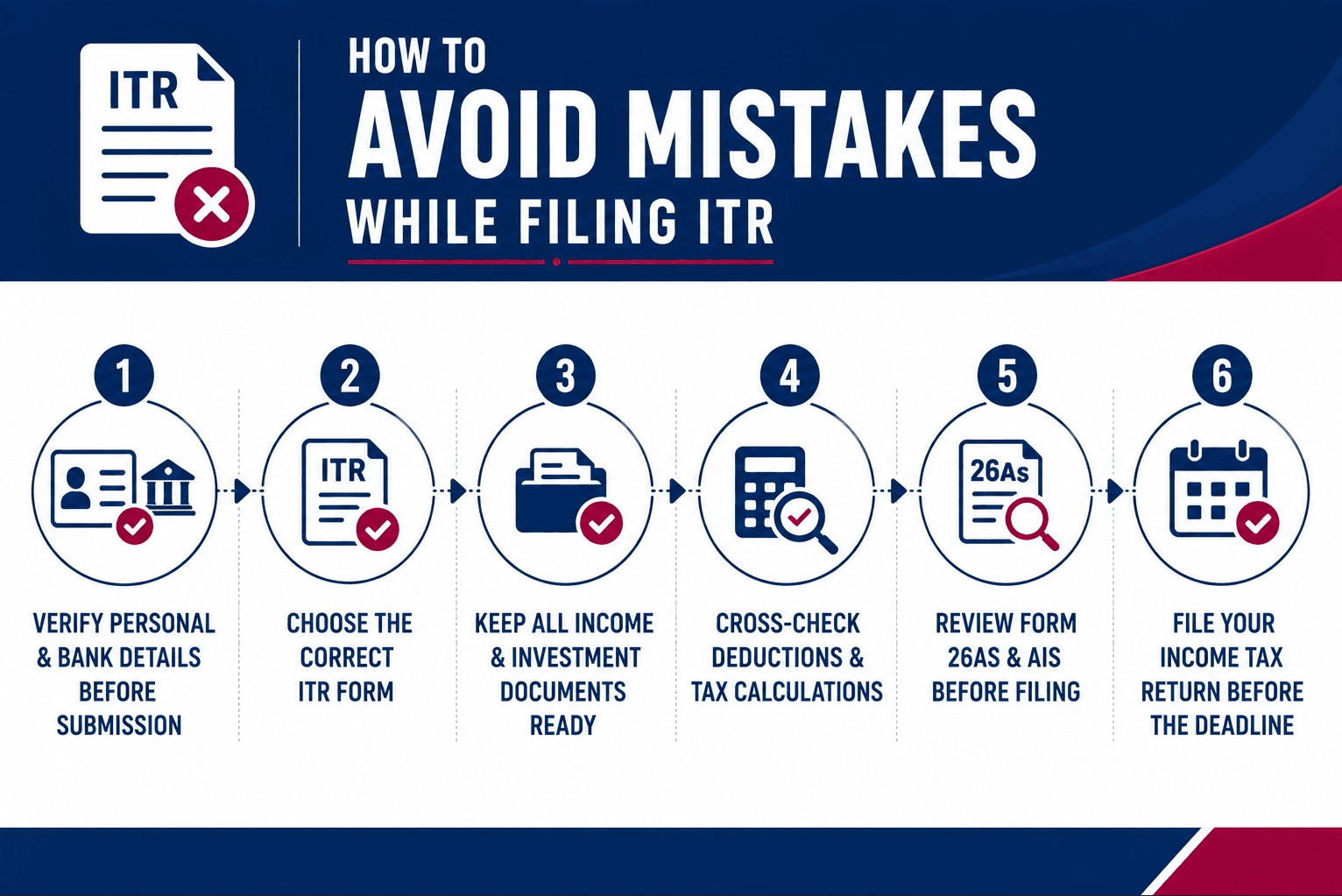
How to Avoid Mistakes While Filing ITR?
It is important to ensure that you file your Income Tax Return (ITR) correctly to prevent the issue of receiving a notice, penalties, delays in refunds, or rejection of your return. Even minor mistakes like choosing the wrong ITR form, entering wrong bank information, or missing income disclosures can lead to problems in the future. The filing process can become smoother and more accurate by carefully reviewing documents, deductions, and tax calculations before submission.
1. Verify Personal and Bank Details Before Submission
Always verify your name, PAN, Aadhaar number, mobile number, email ID, and bank account details before adding them in your ITR. Wrong bank details may delay tax refunds, and wrong personal details may cause problems during verification. Make sure your bank account has been pre-validated and linked with your PAN to process it easily.
2. Choose the Correct ITR Form
The choice of ITR form is crucial for proper filing. Salaried persons, business owners, freelancers and investors are subjected to different forms. The incorrect form may lead to defective return notices by the Income Tax department. Before deciding on the form, check your income sources.
3. Keep All Income and Investment Documents Ready
When filing ITR, make sure to have all the essential documents. These could be Form 16, Form 26AS, AIS, bank statements, investment evidence, home loans statements, and capital gains statements. The record ensures that no income details or deductions are missed.
4. Cross-Check Deductions and Tax Calculations
When you are choosing the old tax regime, be careful of deductions. Section 80C allows deductions of ₹1.5 lakh and Section 80D allows ₹25,000 or ₹50,000 in case of senior citizens. Section 80G has a 50% or 100% deduction on donations. Verify and cross-check TDS details and advance tax payments.
5. Review Form 26AS and AIS Before Filing
Form 26AS and the Annual Information Statement (AIS) include information about tax deducted or collected at source, specified financial transactions, tax payments, demand and refunds, pending and completed proceedings, and other financial information. Match these records to your income records to be sure you are reporting accurate income and to prevent discrepancies when submitting your ITR.
6. File Your Income Tax Return Before the Deadline
Submitting your ITR on time will save you the late-filing charges, interest charges, and last-minute technical problems on the portal. The timely filing also enables quicker refunds and gives time to rectify the mistakes in case of revision in the future.
Incomes That Are Exempt From Income Tax Under The New Tax Regime
Even though the new tax regime offers lower income tax slab rates, many of the deductions under the old tax regime cannot be availed under the new tax regime. Notable among these are the 80C and 80D tax deductions that can only be availed if you are opting for the old tax regime.
But a few types of income are exempt from tax under the new tax regime. These include:
- Interest received from post office savings accounts up to Rs. 3,500 in a FY for single account and up to Rs. 7,000 in a FY for joint account.
- Gratuity payout obtained from employer. Maximum up to Rs. 20 lakh during lifetime.
- Maturity proceeds of Life Insurance policy
- Contributions made into EPS/NPS account by the employer up to Rs. 7.5 lakh in a FY
- Interest received on Employee Provident Fund (EPF) account balance for annual contribution of up to Rs. 2.5 lakh
- Interest earned and maturity amount received from Public Provident Fund (PPF), but without 80C tax deduction benefit on investments
- Interest earned and maturity amount received from Sukanya Sammriddhi Yojana account, but without 80C tax deduction benefit on investments
- Gifts up to Rs. 5000 in a FY received from employer
- Allowances such as food coupons, travel cost, tour allowance, etc. provided to employee for performance of official duties
Frequently Asked Questions (FAQs)

Does income tax calculator calculate Tax Deducted at Source (TDS)?
No, you can only calculate your tax payable for the financial year with income tax calculator.
Is it mandatory to file Income Tax Returns?
Every individual, senior citizen and super senior citizen should file their income tax returns if they earn more than the exemption limit. For individuals, senior citizens and super senior citizens, the exemption limit is Rs.2.5 lakh, Rs.3 lakh and Rs.5 lakh respectively.
Also, if you earn less than the exemption limit and want to claim income tax refund then you should file your income tax returns to claim tax refund.
Also, if you earn less than the exemption limit and want to claim income tax refund then you should file your income tax returns to claim tax refund.
How can I Calculate Tax Online?
You can calculate your income tax online on the basis of your taxable income and income tax slab that you fall in. Your net taxable income is calculated after deducting all the tax-saving investments you made. After deducting all the deductions and exemptions, you are taxed on the basis of income tax slabs applicable on your income.
How can I Calculate tax on salary?
You can calculate tax on salary by calculating your taxable salary which will include your Basic Salary, House Rent Allowance (HRA), Transport Allowance, Special Allowance etc. Once you know your taxable salary, you will know the income tax slab you fall in. Then you can use our income tax slab online to calculate and save taxes online.
What are the new Income Tax Rules?
Income Tax calculation involves a number of complex calculations involved around the income details, deductions and exemptions. The new tax regime does not offer a majority of deductions and establishes a flat tax system. While there are pros and cons of both the tax regimes, currently, a tax payer to free to choose either the old tax regime or the new tax regime and pay taxes accordingly.
This income tax calculator helps you get a better idea about how the tax regime chosen will impact your taxes so that you can make an informed decision.
All you have to do is fill in your details and calculate.
This income tax calculator helps you get a better idea about how the tax regime chosen will impact your taxes so that you can make an informed decision.
All you have to do is fill in your details and calculate.
Can I avail the Income Tax Calculator facility on the official website of Income Tax Department India?
Yes, you can use the income tax calculator in India on the official website of Income Tax Department India. You can make use of the income and tax calculator, tax calculator and deferred tax calculator on the Official Income Tax Department website.
For which assessment year can I calculate my tax liability?
Your tax liability can be calculated for any of the previous financial years. Accurately calculating tax liability for the current FY might be tricky as your income might increase or decrease prior to end of the current FY.
The gross tax liability can be calculated by subtracting applicable tax deductions from your taxable income. As for total income tax liability, it is calculated by subtracting tax credits from gross tax liability
The gross tax liability can be calculated by subtracting applicable tax deductions from your taxable income. As for total income tax liability, it is calculated by subtracting tax credits from gross tax liability
Who can use this income tax calculator in India?
An income tax calculator in India can be used by any salaried or self-employed individual who is eligible to pay taxes during the financial year.
How much tax should I pay on my salary?
Tax must be paid according to the income tax slab rate set by the Income Tax Department and the tax regime chosen by the tax payer. The tax slab determines the percentage of tax payable by different income different groups. Currently you are exempt from paying income tax if your annual taxable income is below Rs. 2.5 lakh for the financial year.
What is the maximum non-taxable income limit?
Non-taxable income limit or minimum exemption limit differs based on the tax regime chosen. Under the new tax regime, the basic exemption limit is ₹4 lakh, while it up to ₹2.5 lakh under the old regime.
However, due to applicability of Section 87A rebate, annual income up to ₹12 lakh is tax-free under the new tax regime, while income up to ₹5 lakh annually is tax-free under the old tax regime.
However, due to applicability of Section 87A rebate, annual income up to ₹12 lakh is tax-free under the new tax regime, while income up to ₹5 lakh annually is tax-free under the old tax regime.
Does everyone have to file their income tax returns?
No, not everyone is required to file an income tax return. Only individuals whose income exceeds the exemption limit as per the Income Tax Act are required to file returns. However, filing ITR is mandatory for claiming refund on tax that has already been deducted. So, individuals seeking income tax refund may decide to file returns even if it is not mandatory.
Can I use the Income Tax Calculator if I have multiple income sources?
Yes, you can calculate income tax for multiple sources of income with the calculator. It supports income from salary, business, capital gains, rent, and other sources.
How to calculate surcharge or rebate on income tax?
The calculator automatically applies surcharge and Section 87A rebate if applicable.
How to calculate income tax on arrears of salary?
Arrears salary can be included under salary income. Also, there is relief from salary arrears under Section 89.
What are the new developments for Income Tax announced in Union Budget 2025?
What are the new developments for Income Tax announced in Union Budget 2025?
The key new developments for income tax announced in the Union Budget 2025 are applicable to the new tax regime. These include:
- Revised slabs under the new tax regime
- Standard deduction increased to ₹75,000
- Section 87A rebate increased to ₹60,000
What is the maximum non-taxable income limit?
Non-taxable income limit or minimum exemption limit differs based on the tax regime chosen. Under the new tax regime, the basic exemption limit is ₹4 lakh, while it up to ₹2.5 lakh under the old regime.
However, due to applicability of Section 87A rebate, annual income up to ₹12 lakh is tax-free under the new tax regime, while income up to ₹5 lakh annually is tax-free under the old tax regime.
However, due to applicability of Section 87A rebate, annual income up to ₹12 lakh is tax-free under the new tax regime, while income up to ₹5 lakh annually is tax-free under the old tax regime.
Can I switch between tax regimes?
Yes it is possible to switch between tax regimes. Salaried individuals can choose their tax regime annually at the time of tax filing. In the case of taxpayers with income from business or profession, the new tax regime is the default, however, they may choose to opt out at the time of filing.
To opt out of the new tax regime, the self-employed taxpayer needs to submit Form 10-IEA prior to filing ITR before due date as per Section 139(1). This form also needs to be submitted to opt out of the old tax regime and file returns under the new regime.
To opt out of the new tax regime, the self-employed taxpayer needs to submit Form 10-IEA prior to filing ITR before due date as per Section 139(1). This form also needs to be submitted to opt out of the old tax regime and file returns under the new regime.
Is the new tax regime better than the old tax regime?
The new tax regime has lower tax rates and fewer deductions and exemptions whereas the old tax regime has deductions covered under section 80C and 80D. The right option depends on your income level, investment pattern, and the deductions that you are eligible to claim.
What deductions are allowed in the new tax regime?
Key deductions in the new tax regime include ₹75,000 standard deduction, employer NPS contribution under Section 80CCD(2), Agniveer Corpus Fund, family pension deduction, and interest on let-out property. Exemptions such as gratuity, leave encashment, and NPS withdrawals are also among the deductions allowed under the new tax regime.
Is income up to ₹12 lakh tax-free under the new tax regime?
Taxpayers under the new tax regime may qualify for a rebate of up to ₹60,000 under Section 87A if their taxable income does not exceed ₹12 lakh, which can effectively reduce their tax liability to zero.
What is the standard deduction under the new tax regime?
The old tax regime has a standard deduction amount of ₹50,000, whereas the new tax regime offers a higher standard deduction of ₹75,000 to salaried workers and pensioners. This deduction leads to less taxable income without the need to provide evidence of investment or expenses.
ARN: PCP/ITC/040723
Sources:
www.etmoney.com/blog/how-to-calculate-your-income-tax-in-5-steps/
www.cleartax.in/s/80c-80-deductions
www.scripbox.com/plan/income-tax-calculator#1
www.economictimes.indiatimes.com/wealth/tax/will-proposed-new-income-tax-slabs-rates-benefit-senior-citizens-heres-the-answer/articleshow/73925187.cms?from=mdr
www.cleartax.in/s/income-tax-slabs#19-20
www.cleartax.in/s/income-tax-slabs
www.economictimes.indiatimes.com/wealth/tax/itr-form-who-is-eligible-to-file-which-tax-return-for-fy-2019-20/articleshow/77199030.cms
www.financialexpress.com/money/income-tax/income-tax-return-filing-by-individuals-who-should-file-and-how-to-file-2/2348463/
www.financialexpress.com/money/income-tax/income-tax-return-filing-5-benefits-of-filing-itr-even-if-your-income-is-not-taxable/2289106/
www.economictimes.indiatimes.com/wealth/tax/incomes-that-are-exempted-under-the-proposed-new-tax-regime/articleshow/74074285.cms
www.icicidirect.com/knowledge-center/article/5-steps-to-calculate-individual-tax-liability
www.incometax.gov.in/iec/foportal/help/individual/return-applicable-1
This calculation is generated on the basis of the information provided and is for assistance only and is not intended to be and must not alone be taken as the basis for an investment decision. The tax calculations stated above are basic tax calculations for the Financial Year 2021-22 & 2022-23 basis our broad understanding of the income tax laws and are not specific advice in regard to your personal tax and investment matters. . You are advised to seek an opinion of Your tax advisor in relation to the exact tax calculation, tax benefits and liabilities applicable to You. Axis Max Life Insurance Company Limited expressly disclaims any liability to any person, if any decision is taken basis the above tax calculation.
1Disclaimer: The assumed rate of return (4% p.a. and 8% p.a.) shown in the illustrative example are not guaranteed and they are not the upper or lower limits of what you might get back as the value of your policy depends on a number of factors including future investment performance | The amount shown is for 30-year-old healthy male, 15 years premium payment term, 34 years policy term with Axis Max Life Online Saving Plan (Unit Linked Non Participating Individual Life Insurance Plan | Life Insurance is available in this product)
*Disclaimer:Applicable for Titanium variant of Axis Max Life Smart Fixed-return Digital (Premium payment of 5 years, Policy term of 10 years) and a healthy male of 18 years old paying Rs. 20,000/- monthly (exclusive of all applicable taxes)
**Disclaimer:Healthy non-smoking male, 24 years, 2 cr cover,25 years policy term,25 year premium payment term, exclusive of GST for Axis Max Life Smart Secure Plus Plan (UIN:104N118V08)
www.etmoney.com/blog/how-to-calculate-your-income-tax-in-5-steps/
www.cleartax.in/s/80c-80-deductions
www.scripbox.com/plan/income-tax-calculator#1
www.economictimes.indiatimes.com/wealth/tax/will-proposed-new-income-tax-slabs-rates-benefit-senior-citizens-heres-the-answer/articleshow/73925187.cms?from=mdr
www.cleartax.in/s/income-tax-slabs#19-20
www.cleartax.in/s/income-tax-slabs
www.economictimes.indiatimes.com/wealth/tax/itr-form-who-is-eligible-to-file-which-tax-return-for-fy-2019-20/articleshow/77199030.cms
www.financialexpress.com/money/income-tax/income-tax-return-filing-by-individuals-who-should-file-and-how-to-file-2/2348463/
www.financialexpress.com/money/income-tax/income-tax-return-filing-5-benefits-of-filing-itr-even-if-your-income-is-not-taxable/2289106/
www.economictimes.indiatimes.com/wealth/tax/incomes-that-are-exempted-under-the-proposed-new-tax-regime/articleshow/74074285.cms
www.icicidirect.com/knowledge-center/article/5-steps-to-calculate-individual-tax-liability
www.incometax.gov.in/iec/foportal/help/individual/return-applicable-1
This calculation is generated on the basis of the information provided and is for assistance only and is not intended to be and must not alone be taken as the basis for an investment decision. The tax calculations stated above are basic tax calculations for the Financial Year 2021-22 & 2022-23 basis our broad understanding of the income tax laws and are not specific advice in regard to your personal tax and investment matters. . You are advised to seek an opinion of Your tax advisor in relation to the exact tax calculation, tax benefits and liabilities applicable to You. Axis Max Life Insurance Company Limited expressly disclaims any liability to any person, if any decision is taken basis the above tax calculation.
1Disclaimer: The assumed rate of return (4% p.a. and 8% p.a.) shown in the illustrative example are not guaranteed and they are not the upper or lower limits of what you might get back as the value of your policy depends on a number of factors including future investment performance | The amount shown is for 30-year-old healthy male, 15 years premium payment term, 34 years policy term with Axis Max Life Online Saving Plan (Unit Linked Non Participating Individual Life Insurance Plan | Life Insurance is available in this product)
*Disclaimer:Applicable for Titanium variant of Axis Max Life Smart Fixed-return Digital (Premium payment of 5 years, Policy term of 10 years) and a healthy male of 18 years old paying Rs. 20,000/- monthly (exclusive of all applicable taxes)
**Disclaimer:Healthy non-smoking male, 24 years, 2 cr cover,25 years policy term,25 year premium payment term, exclusive of GST for Axis Max Life Smart Secure Plus Plan (UIN:104N118V08)
Check out the different Online Insurance Plans from Axis Max Life!
- Axis Max Life Smart Secure Plus Plan
 In case of your demise during policy term, your family will receive a comprehensive death benefit for your familyTo assist you achieve your life goals, there are guaranteed maturity advantages, income benefits, and guaranteed additionsKnow moreLump sum, short-term, long-term, and whole-life income options with distinctive benefits are available
 - Axis Max Life Smart Wealth Plan
Comprehensive death benefit for your family member(s) in case of your unfortunate demise during policy term
Guaranteed maturity benefits/Income Benefit and accrued guaranteed additions to help meet your life goals
Know moreMultiple variants -lumpsum, short term income, long term. income, and whole life Income with unique benefits
- Long-Term IncomeGuaranteed income benefit for 25 or 30 years after the policy period ends, as per the sub variant selectedTerminal benefit that equals total premiums paid, post completion of the payout period payable to nomineeKnow moreTwo premium payment options - 6 and 10 years to be chosen as per suitability of the plan for your needs
- Term Plan with Return of Premium
Option to receive the premiums paid back on successful survival of the insured till end of policy term
Death benefits for your family members in case of any eventuality leading to the loss of your life
Know moreLimited pay options to pay for term plans with return of premium - 5 Pay, 10 Pay, 12 Pay, 15 Pay, or 60 Pay
- Axis Max Life Critical Illness and Disability Rider
Additional protection against upto 64 critical illnesses depending on the rider variant you select
Total and Permanent Disability Cover on the occurrence of disability arising from sickness or injury
Know moreWellness benefit to avail a discount on annualised renewal premiums as per healthy weeks you accumulate
Share your Valuable Feedback

4.7
Rated by 45203 customers
Was the Information Helpful?
Very Good
Popular Searches

Online Sales Helpline
- Whatsapp: +91-7428396005Send ‘Quick Help’ from your registered mobile number
- Phone: +91-124-648-890009:30 AM to 06:30 PM
(Monday to Sunday except National Holidays) - service.helpdesk@axismaxlife.comPlease write to us incase of any escalation/feedback/queries.
Customer Service
- Whatsapp: +91-7428396005Send ‘Hi’ from your registered mobile number
- 1860-120-55779:00 AM to 6:00 PM
(Monday to Saturday) - service.helpdesk@axismaxlife.comPlease write to us incase of any escalation/feedback/queries.
NRI Helpdesk
- +91-11-71025900 , +91-11-61329950 (Available 24X7 Monday to Sunday)
- nri.helpdesk@axismaxlife.comPlease write to us incase of any escalation/feedback/queries.
We would like to hear from you
Let us know about your experience or any feedback that might help us serve you better in future.
Do you have any thoughts you’d like to share?